

I recently visited with some friends who have been in the ADR business for years. I shared with them my observations about mediation work (since I have served as a mediator for nearly 10 years).
My takeaway? It’s an unusual business.
We start a mediation with a defined group of people: attorneys, clients and maybe insurance adjusters. We use a specific set of documents. We work with a common set of facts. Counsel usually exchange their mediation briefs so there are no hidden issues. During the course of the day there are no filings, motions or rulings. None of the facts or documents change. At the end of the day we have the same group of people we started with, the same documents, the same facts and the same law. But if the mediation is successful (and most are) then at the end of the day the attorneys and clients walk out with different relationships than they had at the start of the day – and sometimes those differences are profound. Lots of money changes hands. Parties save hundreds of thousands of dollars of legal fees. They move on with their lives.
What happens during the day to bring about such a big result? Only talk. Nothing more. Only talk.
It’s a strange business.
What kinds of things are said during a day to make this happen? As a mediator, the only tools I work with are my voice, my eyes, my ears and my thoughts. How do I use those tools to bring about such monumental shift in people’s positions? What happens to make this possible?
More often than not, it’s a change of perspective.
What percentage of litigants and their attorneys come to mediation expecting failure? I’d say most. They’re hopeful – but not optimistic, especially after hearing the initial exchange of demands and offers.
“They aren’t taking this seriously.”
“We’re wasting our time.”
“They need to come up with a real offer.”
“This is outrageous.”
Who hasn’t heard these comments – and more – at the start of a mediation? Counsel and parties come to mediation believing – even knowing – that the other side is in a different universe altogether and that they aren’t acting either reasonably or rationally. The change in perspective that so often leads to resolution occurs as these parties start to sense that the other side may actually be willing to act more realistically than they ever hinted at before. The magic of mediation consists in discovering what a party may be willing to do and then matching that up with what the other side is willing to do.
When one side begins to see that the other side may actually act reasonably, a change of perspective occurs – and then the magic happens.
On July 23, 2025 at Noon the San Mateo County Bar Association will host an MCLE program via Zoom “Why the Other Side Won’t Settle (and What You Can Do About It).” To attend this advanced one-hour program examining key settlement techniques, sign up here: https://www.smcba.org/?pg=events&evAction=showDetail&eid=304378&evSubAction=viewMonth&calmonth=202507.
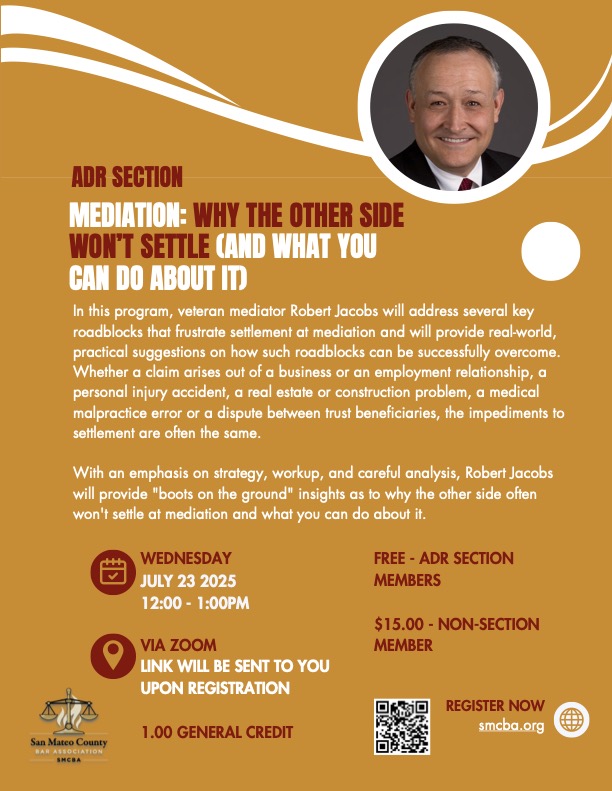
Robert Jacobs practiced law for more than 30 years. He has mediated cases since 2016. He views himself as a facilitator, a river guide and an occasional bulldog. He finds that two of the hallmarks of successful mediation are advance preparation and tenacity. He’s affiliated with Judicate West, where he mediates Business, Real Estate, Employment, Construction, Personal Injury, Medical Malpractice and Trust Litigation cases.